King or lunatic?
This is one of the questions you face when you consider the life of Hong Kong citizen Tsang Tsou-choi 曾灶財. Originally named Tsang Choi, he was born in Liantang village, Guangdong province on 12 November 1921. He came to Hong Kong at 16, lived with his uncle Sin Bak in Yuen Long and made a living as a peasant. He had also worked as a pipe-cleaner, coolie and garbage collector. He married Leung Fuk-choi who was 15 years his junior and they had 4 daughters and 4 sons.
Tsang started his street calligraphy in 1956, at the age of 35. Tsang had only 2 years of schooling, so in terms of calligraphy, his script was idiosyncratic perhaps even crude. He was definitely prolific – his writings could be seen on building walls, lampposts, utility boxes and other public property around Hong Kong. Over a period of 51 years until his death in 2007, it is estimated that he produced 55,845 pieces of work at 80 locations over Hong Kong. He’d even written on the walls and curtains of his home. Even the clock and his huxiang zheng "home return permit” were covered with his writings. So what drove this man to such passion and why was he allowed to continue?
Looking at his writings, one certainly gains a sense of rage and injustice. This was a man with an obsession. Tsang was convinced that most of the land of Kowloon belonged to his ancestors. One version was that his great grandfather Tsang Gwong-jing, was a prime minister in the Zhou Dynasty and owned a lot land in Hong Kong. As Hong Kong had become a British colony, he complained that his ancestor’s land had been appropriated by the British. Thus began his gripe against the authorities. His writings usually included his name, his title九龍皇帝 “King of Kowloon”, his family tree and the statement “Down with the Queen of England”.
Tsang was arrested several times for his graffiti but remarkably, he was usually only given a warning or a small fine. For example, on 18 August 2001, Tsang wrote his ancestral record on a stone pillar at the Star Ferry Pier. He was taken away for questioning and later released unconditionally. On 22 September 2002, Tsang was prosecuted and fined $500 for painting in the vicinity of Jardine House in Central. This was the last prosecution on record.
His two eldest daughters had emigrated to Britain and Holland. Tsang was proud of their settling abroad. His Majesty proclaimed “At least she can meet Queen Elizabeth and settle the dispute with me one day, and talk her into returning to me the Kowloon illegally occupied by Britain.”
Next - Calligraphy or graffiti? Art or defacement?
From now till 31 May 2011, you need not travel around Hong Kong to view the King of Kowloon’s “art”. There is an exhibition at ArtisTree, 1/F Cornwall House, Taikoo Place, Island East (free admission).
Showing posts with label Hong Kong. Show all posts
Showing posts with label Hong Kong. Show all posts
Wednesday, 25 May 2011


Friday, 13 May 2011
Hong Kong weather
Yesterday, the Hong Kong Observatory issued a 'Very Hot Weather' warning with the temperature hitting 35°C in Tai Po and Sheung Shui. Then this morning, the Hong Kong Observatory raised an ‘Amber Rainstorm Warning' signal at 5.30 am. This brings me back 8 years. I arrived with my family in August and it was miserable. It just poured constantly and it was terribly hot compared to the winter we had just left behind. The children were about to start school and we had to organize school supplies, uniforms plus all things necessary to feed and clothe a family. It was so humid the tiled walls were dripping with condensation. Each time the sky cleared, we’d try to dash out to do some shopping only to have to rush back in before we even got to the front gate. We’d go out dry and come back in wet!
On the first day of school, we woke up to something new to us……. a ‘Black Rainstorm Warning’ which meant all schools were closed for the day. Well, it seems some black clouds in Hong Kong have a silver lining!
Whilst on the topic of Hong Kong’s weather, here’s a quick synopsis. Hong Kong’s climate is sub-tropical tending towards temperate for half of the year. From May to August, it is hot and humid with occasional showers and thunderstorms, particularly during the mornings. Afternoon temperatures often exceed 31°C whereas at night temperatures generally remain around 26° with high humidity. July to September are months most likely to be affected by tropical cyclones, some reaching typhoon strength (maximum winds of 118km per hour or more). The weather then improves as we head towards winter. During November and December, there are pleasant breezes, plenty of sunshine and comfortable temperatures. January and February are cloudier, with occasional cold fronts followed by dry northerly winds. It is not uncommon for temperatures to drop below 10°C. March and April can also be very pleasant although there can be spells of high humidity with fog and drizzle disrupting air and ferry traffic.
Well, I’d say it’s not much of a day for going out (it is Black Friday, after all) so perhaps some baking would be in order.
For the meaning of weather and fire warnings issued by the Hong Kong Observatory, refer to http://www.weather.gov.hk/wservice/wservice.htm ).
On the first day of school, we woke up to something new to us……. a ‘Black Rainstorm Warning’ which meant all schools were closed for the day. Well, it seems some black clouds in Hong Kong have a silver lining!
Whilst on the topic of Hong Kong’s weather, here’s a quick synopsis. Hong Kong’s climate is sub-tropical tending towards temperate for half of the year. From May to August, it is hot and humid with occasional showers and thunderstorms, particularly during the mornings. Afternoon temperatures often exceed 31°C whereas at night temperatures generally remain around 26° with high humidity. July to September are months most likely to be affected by tropical cyclones, some reaching typhoon strength (maximum winds of 118km per hour or more). The weather then improves as we head towards winter. During November and December, there are pleasant breezes, plenty of sunshine and comfortable temperatures. January and February are cloudier, with occasional cold fronts followed by dry northerly winds. It is not uncommon for temperatures to drop below 10°C. March and April can also be very pleasant although there can be spells of high humidity with fog and drizzle disrupting air and ferry traffic.
Well, I’d say it’s not much of a day for going out (it is Black Friday, after all) so perhaps some baking would be in order.
For the meaning of weather and fire warnings issued by the Hong Kong Observatory, refer to http://www.weather.gov.hk/wservice/wservice.htm ).
Monday, 9 May 2011
Buddha's birthday and Cheung Chau Bun Festival
The Lord Buddha's birthday is celebrated on the 8th day of the 4th month of the Lunar calendar. This year, it falls on May 10th i.e. tomorrow. It is a holiday in Hong Kong and even if you are not a Buddhist, there are places you can visit to be part of the festivities. There are lots of Buddhist temples in Hong Kong but probably the best known is at the Po Lin Monastery on Lantau Island.
A giant statue of the sitting Buddha is set serenely atop the Ngong Ping Plateau. It is the world's largest outdoor bronze statue of the sitting Buddha (there are larger statues of the reclining Buddha). You can admire it from afar or better yet, brave the 200 odd step climb up to the platform where the statue is seated to view it up close and to take in the breathtaking mountain scenery of Lantau Island. From there, it is short walk to Wisdom Path and a vegetarian lunch. Wisdom Path is an outdoor replica of the centuries old Heart Sutra, one of the world's best known prayers revered by Buddhists, Confucians and Taoists alike.
The Bun Festival takes place in Cheung Chau, another colorful outlying island of Hong Kong. Whilst it is celebrated on the same day as Lord Buddha's birthday, it is actually a Taoist festival. As part of the celebrations, a 60 foot tower is erected in front of the Pak Tai Temple. The Pak Tai Temple was erected in 1783 and is dedicated to the popular Taoist God of the Sea. Originally, people scrambled up a bamboo tower covered with sweet buns to see who could collect the most. The race for buns came to an abrupt end in 1978 when the bun tower collapsed, injuring 100 people. After a break of 26 years, the bun climb was re-introduced in 2005. For safety reasons, the tower is erected of metal scaffolding and the buns are plastic replicas. Instead of a free for all, the climb is now limited to 12 finalists. The scramble for the plastic buns will take place at midnight where they race to get to the top-most 'luckiest buns".
Th edible sweet buns with fortune messages printed in red can be purchased from the island's 2 bun makers. Leading up to this day, the entire island's residents go vegetarian for 3 days (even McDonald's) until the parade. The highlight of the parade must surely be the costumed children carried atop poles to look like they are floating.
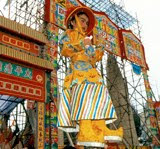
Picture courtesy of Hong Kong Tourism Board website
Have a great day out tomorrow!
Subscribe to:
Posts (Atom)